

Current Issue

Vol. 3 No. 1 (2026): In Progress

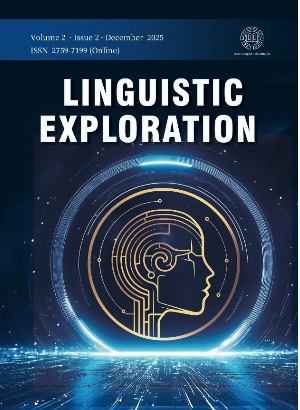
Journal Cover

EISSN: 2759-7199

Aims:
The mission of Linguistic Exploration is to foster a deeper understanding of language as a complex and dynamic system that is deeply intertwined with human cognition, society, and culture. The journal aims to provide a platform for the dissemination of cutting-edge research in, Encourage the exchange of ideas and methodologies across different linguistic disciplines and theoretical frameworks,encourage the exploration of linguistic diversity and the documentation of endangered languages.
Submissions should be of high academic quality, contribute new insights to the field, and have not been pub.
Scope:
Linguistic Exploration invites submissions in the form of original research articles, review articles, and short communications in the following areas:

  • Phonetics and phonology
  • Morphology
  • Syntax
  • Semantics and pragmatics
  • Sociolinguistics
  • Computational linguistics
  • Language acquisition
  • Historical linguistics
  • Linguistic typology

Recent Articles

A Comparative Analysis of the Figurative Language in Arabic and South African Languages


169 (Abstract) 57 (Download) PDF

Arabic and South African languages contain rich idiomatic expressions, many of which are based on body-related metaphors that play an important role in everyday communication. This study compares body-part idioms in Arabic and South African to examine how physical body concepts are used to express abstract meanings. Most previous research has primarily focused on English idioms, leaving a notic... more

On the Dual Nature of Sem-Phrases in Hungarian: Negative Quantifiers or Negative Indefinites?


496 (Abstract) 298 (Download) PDF

Sem-phrases in Hungarian are negative indefinites accompanied by the negative emphatic particle sem ‘neither’. Preverbal sem-phrases differ from postverbal ones in that the former behave as negative quantifiers (NQs), while the latter resemble s-words, which are negative concord items (NCIs) like senki ‘nobody’. By adopting Ladusaw’s distinction between syntactic vs. semantic licensing, the pap... more

Linguistic Geoengineering: A New Paradigm for Discursive Infrastructure and Public Persuasion


740 (Abstract) 367 (Download) PDF

This theoretical paper (1) defines linguistic geoengineering as a theoretical framework, (2) distinguishes its unique characteristics from established theories of language and power, and (3) analyzes its implications for public persuasion and democratic engagement. Linguistic geoengineering, a novel framework for analyzing language, power, and public influence, is defined as the deliberate, sys... more

A Metalinguistic Judgmental Analysis of Pakistani English Phonology by Odki Native Speakers


761 (Abstract) 337 (Download) PDF

The study aims to explore the metalinguistic judgments of English syllable structures and lexical stress patterns perceived by Odki English as a Second Language (ESL) adult learners. The paper lays emphasis on phonological adjustments in Pakistan English spoken by the native Odki speakers and especially in their word stress and syllabification. The study examines syllables and stress perception... more

Humor Construction through Metaphor in a Stand-Up Comedy under Conceptual Blending Theory: A Case Study of The King of Comedy


382 (Abstract) 290 (Download) PDF

Humor is essential in daily life and as linguistic research advances, its mechanisms have attracted increasing scholarly attention. Metaphor as a fundamental way humans conceptualize the world plays a key role in constructing humor. And stand-up comedy, combining verbal artistry with social critique, offers rich naturalistic data for linguistic analysis. To better understand how humor can be co... more

View All Issues >